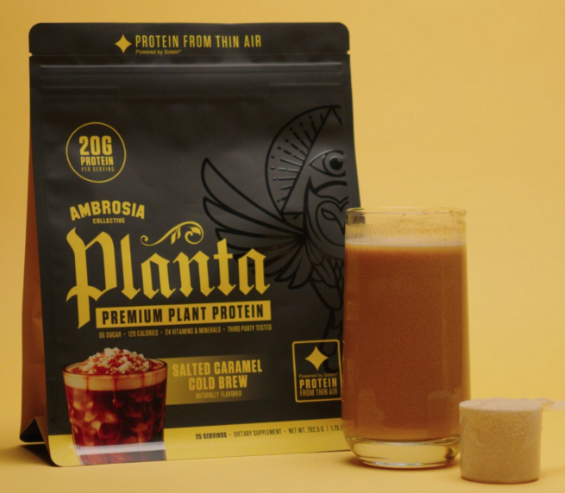
Ambrosia Collective has launched Planta Powered by Solein®, a protein powder formulated with Solar Foods' proprietary air-based protein ingredient, marking the first commercialized U.S. product built on the Finnish biotech's single-cell protein platform. The launch positions Ambrosia Collective as an early route-to-market vehicle for an ingredient that sidesteps conventional agricultural supply chains entirely — a meaningful differentiator as functional beverage and sports nutrition brands wrestle with commodity protein volatility and sustainability mandates from retail partners.
Solein® is produced through a gas-fermentation process that converts carbon dioxide, hydrogen, and oxygen into a high-protein biomass, eliminating the crop-input costs and weather-exposure risks that routinely squeeze whey, pea, and soy protein suppliers. While Ambrosia Collective has not disclosed launch volume or a case-equivalent sales target, the debut SKU establishes the ingredient's first domestic commercial footprint ahead of anticipated broader co-pack and contract-manufacturing licensing discussions with U.S. beverage and nutrition producers.
From a supply-chain standpoint, the introduction of a fermentation-derived, non-animal protein at the ingredient level carries real implications for functional RTD formulators and protein-powder brands evaluating their sourcing playbooks. Buyers negotiating with co-manufacturers on protein inclusion rates are increasingly required to document supply resilience and environmental impact; Solein®'s decoupling from agricultural land use addresses both pressure points simultaneously. Cold-chain requirements for the finished powder have not been specified, but the ingredient's biofermentation origin suggests ambient-stable handling comparable to existing plant-protein concentrates.
On the distribution side, Ambrosia Collective's go-to-market approach for Planta appears to be direct-to-consumer initially, consistent with how emerging functional nutrition brands build trial velocity and gather depletions data before approaching wholesale and three-tier channels. A DTC-first posture also allows the brand to accumulate the sell-through proof points that retail buyers and potential wholesale partners will require before committing to planogram placement or end-cap programs. Expansion into off-premise specialty and natural grocery channels — where functional protein products have seen consistent velocity gains — would be the logical next step if early DTC depletions support the case.
The broader market context is favorable. Functional beverage and sports nutrition are two of the fastest-growing segments in the U.S. non-alc category, and retail buyers are actively seeking differentiated protein sources that can anchor a sustainability narrative on-shelf. For ingredient suppliers and contract manufacturers tracking novel protein inputs, Solar Foods' entry through a branded consumer product — rather than a quiet B2B ingredient listing — is a deliberate signal to the formulation and co-pack community. As regulatory familiarity with Solein® grows and production capacity scales, the ingredient could realistically move from novelty SKU to specification-listed option within functional RTD development pipelines inside 24 months.
Written by Michael Politz, Author of Guide to Restaurant Success: The Proven Process for Starting Any Restaurant Business From Scratch to Success (ISBN: 978-1-119-66896-1), Founder of Food & Beverage Magazine, the leading online magazine and resource in the industry. Designer of the Bluetooth logo and recognized in Entrepreneur Magazine's "Top 40 Under 40" for founding American Wholesale Floral, Politz is also the Co-founder of the Proof Awards and the CPG Awards and a partner in numerous consumer brands across the food and beverage sector.
.png)