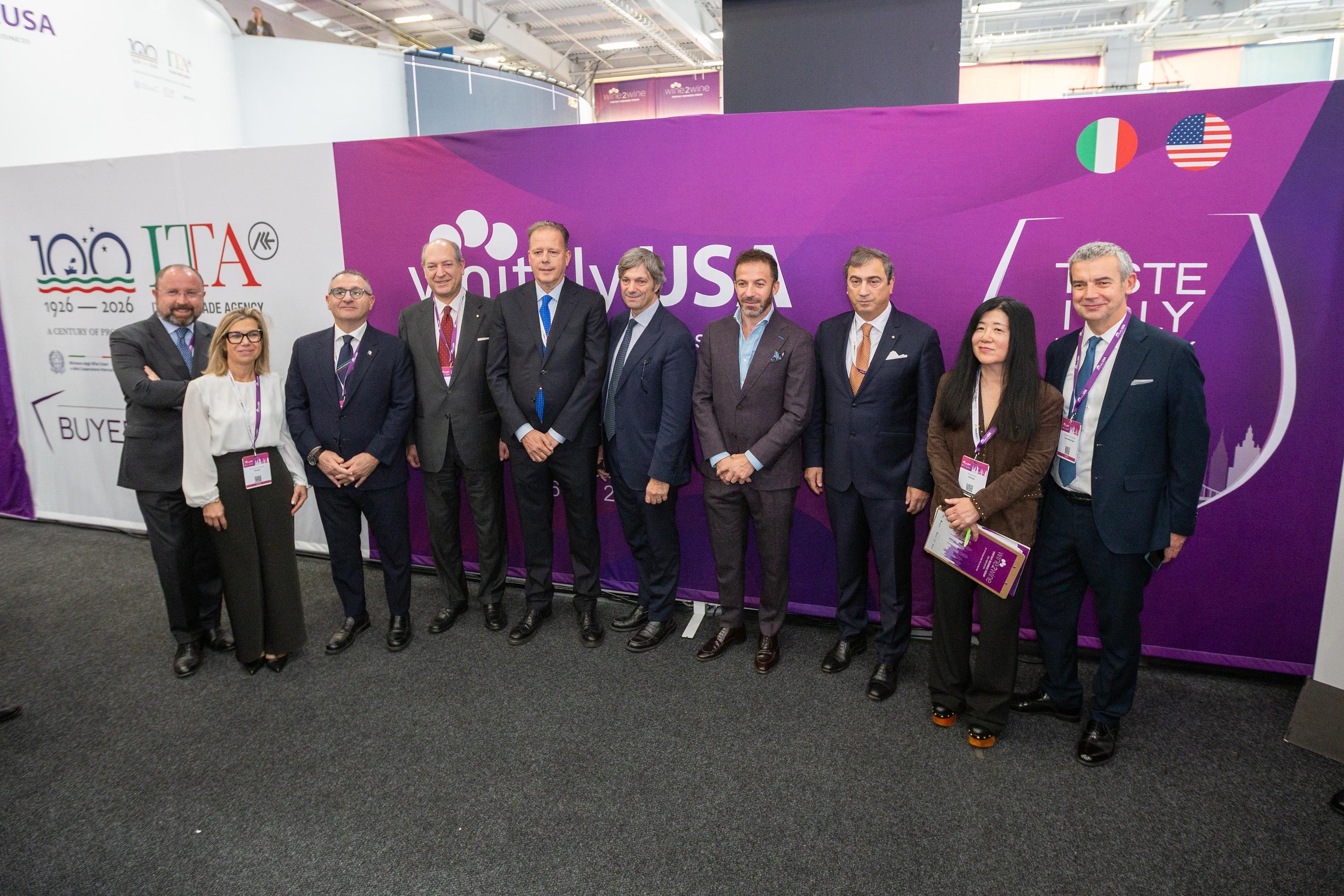
Italy's wine trade apparatus descended on Pier 36 in New York on October 26 for the third edition of Vinitaly.USA, a two-day B2B showcase organized by Veronafiere and the ITA – Italian Trade Agency that puts 300 exhibitors and 2,500 Italian wine labels in front of U.S. importers, wholesalers, and on-premise buyers. The event's central commercial argument: Italy's existing foothold in the U.S. market is large, but the addressable opportunity is nearly twice as large.
The Market Numbers
According to the UIV-Vinitaly Observatory, 35 million U.S. consumers already drink Italian wine — the highest penetration among all wine-importing nations — but that figure represents fewer than half of the approximately 90 million regular wine consumers in the country. Organizers framed the remaining 50-plus million as a reachable audience, requiring coordinated investment across supplier marketing, distributor education, and retail planogram placement. On the export side, Italy has already crossed the $1 billion threshold in U.S. wine shipments and holds the top position among foreign suppliers by volume and second place by value. Italy's total wine exports reached a record €7.8 billion in 2025, with the U.S. remaining the primary market outside the EU. The broader EU wine category shipped approximately $4.9 billion worth of product to the U.S. in 2025 alone.
Consumer Trends Reshaping the Category
Research conducted for the event, drawing on a Wine Market Council survey, surfaced consumption-occasion data that carry direct implications for how Italian wine is positioned across the three-tier system. While on-premise pairing with food remains the dominant occasion — 63% of regular wine consumers drink wine with a meal — 34% now mix wine into cocktails, 30% consume it chilled over ice, and 75% of regular wine drinkers report consuming wine in ways that depart from traditional occasions. Those behavioral shifts are being driven by on-premise experiences (50% influence), family habits (60%), and social media (30%), giving importers and chain-account buyers clear levers for programming and menu integration.
Generationally, Italian wine holds a structural advantage that organizers believe can be leveraged in distributor sell-in conversations. California wines show heavy concentration among consumers aged 55 and older — that cohort accounts for more than 70% of California wine sales volume — while Italian wines demonstrate a more balanced age distribution, including stronger relative performance among younger legal-drinking-age consumers. That skew matters for off-premise retail buyers building planograms around incremental volume rather than defending an aging core.
Federico Bricolo, President of Veronafiere, acknowledged the complexity of the current trade environment while pressing the growth case. "The United States is the primary target market for Veronafiere and Italian wine, and it continues to offer tremendous potential that requires investment and sustained commitment," he said. "Collaboration between businesses and institutions is essential to supporting the competitiveness of our wineries and helping them reach new consumers and explore new markets." Giovanni Sacripante, General Manager of Veronafiere, reinforced the point, noting that the opportunity spans both fine-dining positioning and the emerging, more versatile consumption occasions younger cohorts favor.
Route-to-Market and Forum Activity
The exhibitor roster at Vinitaly.USA covers the full range of Italian wine trade infrastructure: individual estates, regional associations representing Friuli Venezia Giulia, Lazio, Sardinia, Umbria, and Emilia-Romagna, and major consortia including Brunello di Montalcino, Prosecco DOC, Lugana DOC, Sicilia DOC, and delle Venezie DOC. That breadth signals Italian wine's intent to present a coordinated route-to-market front to U.S. wholesalers and importers rather than relying solely on individual brand pull-through.
Running concurrently, the 13th edition of the wine2wine Vinitaly Business Forum added more than 20 sessions covering market trends, wine tourism, and distributor education, giving trade attendees structured context beyond the tasting floor. For Italian producers seeking new importer or distribution agreements, the forum sessions represent some of the most direct access to U.S. channel partners the market offers outside of individual sales calls. Italian Trade Agency President Matteo Zoppas described New York as "a strategic gateway to the entire American market" and positioned Vinitaly.USA as "a concrete tool for business development" backed by active Italian government support at the ministerial level.
Written by Michael Politz, Author of Guide to Restaurant Success: The Proven Process for Starting Any Restaurant Business From Scratch to Success (ISBN: 978-1-119-66896-1), Founder of Food & Beverage Magazine, the leading online magazine and resource in the industry. Designer of the Bluetooth logo and recognized in Entrepreneur Magazine's "Top 40 Under 40" for founding American Wholesale Floral, Politz is also the Co-founder of the Proof Awards and the CPG Awards and a partner in numerous consumer brands across the food and beverage sector.