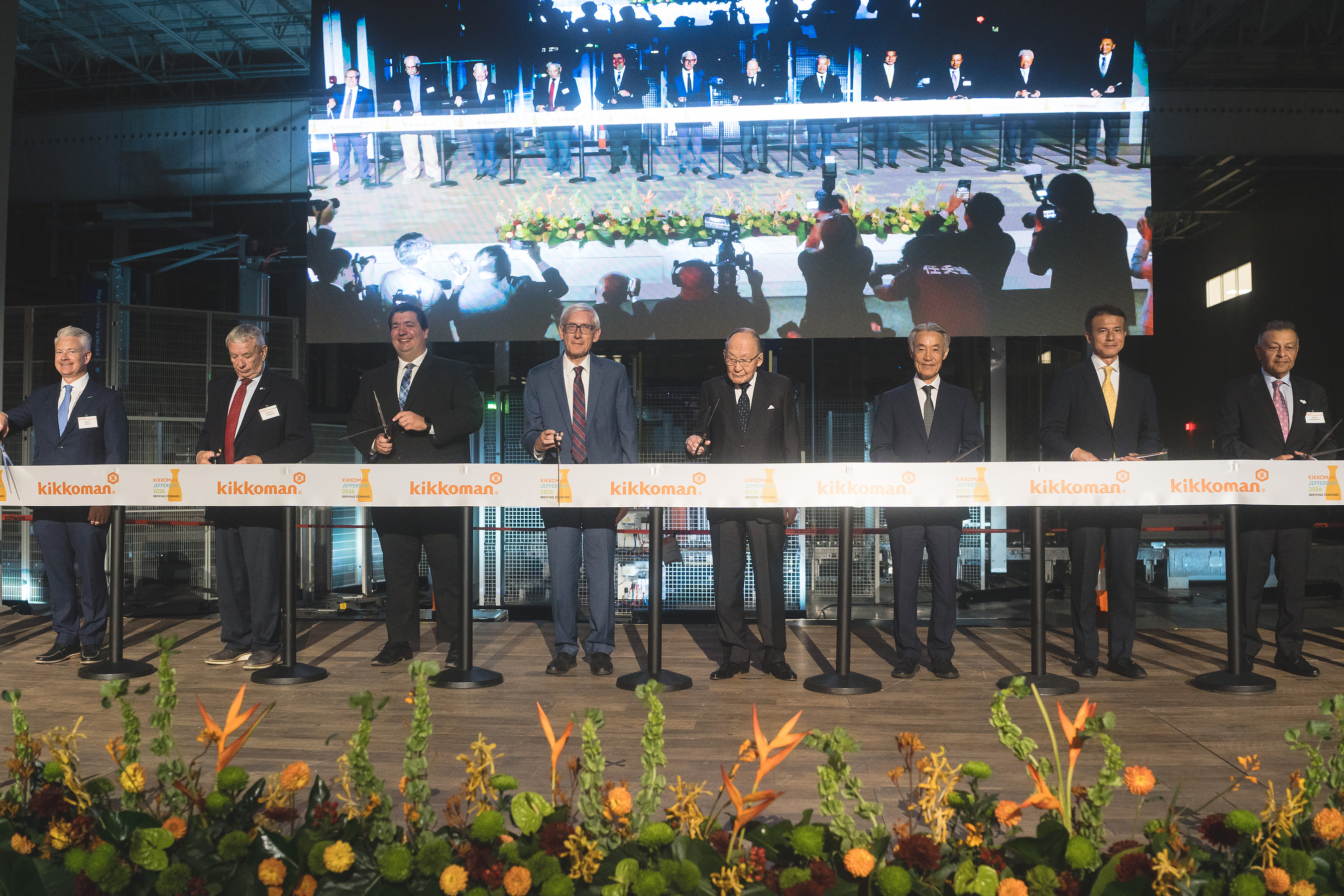
Kikkoman Foods, Inc. (KFI) opened the doors on its third U.S. production facility in Jefferson, Wisconsin this week, with product shipments beginning fall 2026. The 240,000-square-foot brewing plant represents a $560 million investment phased over ten years and positions the world's leading soy sauce manufacturer to accelerate growth across retail, foodservice, and food manufacturing supply channels throughout North America.
KFI's soy sauce business in North America has grown at an average annual rate of more than 6% over the past decade — a sustained depletion curve that has strained existing capacity at the company's Walworth, Wisconsin and Folsom, California plants. The Jefferson facility is designed to absorb that volume pressure while also enabling SKU diversification into teriyaki sauce, glazes, and non-soy-based liquid seasonings, offered in packaging formats spanning glass, BPA-free plastic, industrial drums, and bulk sizing. The highly flexible manufacturing layout is engineered to handle multiple product viscosities on the same line, a co-packing-ready infrastructure advantage that shortens changeover cycles for foodservice and food manufacturing customers running private-label or contract-brewing programs.
Capacity and Supply-Chain Context
The Jefferson plant sits within the city's planned Food & Beverage Innovation Campus, giving KFI proximity to agricultural input suppliers — a critical cold-chain and sourcing efficiency for a brewer whose process depends on high-quality water and fermentation-grade grain. Advanced digital manufacturing tools enable paperless operations, real-time data visualization, and enhanced ingredient traceability, capabilities increasingly demanded by retail planogram buyers and foodservice distributors conducting supplier audits. The facility's sustainability targets — a greater than 50% reduction in CO2 emissions, a greater than 30% reduction in water consumption per unit, and a 100% recycling rate by 2030 — align with procurement criteria now embedded in major grocery and broadline distributor sustainability scorecards.
The Wisconsin Economic Development Corporation committed up to $15.5 million in performance-based tax credits tied to job creation and capital investment benchmarks. KFI says the Jefferson plant, combined with ongoing Walworth operations, adds more than 80 high-paying manufacturing positions to southeastern Wisconsin. The company is partnering with regional workforce development and technical education institutions to pipeline talent into advanced food and beverage manufacturing roles — a supply-chain workforce strategy increasingly common among large-scale beverage ingredient producers facing skilled-labor shortages.
Market Position and Outlook
KFI has held the leading share of the U.S. soy sauce market for more than a decade. With global culinary influences continuing to reshape the foodservice and retail flavor categories — driving on-premise menu adoption of Asian-inspired sauces and expanding off-premise shelf sets — the company is betting that additional domestic brewing capacity is the fastest route to sustained volume growth. Expanding domestic production also reduces exposure to cross-border logistics costs and import lead times, a relevant supply-chain hedge for a manufacturer supplying broadline distributors and food manufacturers on tight replenishment windows.
"This facility gives us proximity to key agricultural suppliers, access to high-quality water our brewing process demands, and a workforce rooted in the same values that have guided Kikkoman for generations," said Yuzaburo Mogi, Director Chairman of the Board and Honorary CEO of KFI, underscoring how vertical supply-chain integration and input-source reliability remain central to the brand's North American growth thesis.
For operators and distributors tracking the liquid-condiments segment, KFI's Jefferson opening signals continued capacity tightening in fermented sauce manufacturing — and a supplier investing heavily to stay ahead of foodservice volume. Buyers across the foodservice supply chain and retail grocery should expect expanded SKU availability and improved fill rates as the Jefferson plant reaches full operating throughput. More coverage of beverage ingredient manufacturing expansion is available in our manufacturing and production section.
Written by Michael Politz, Author of Guide to Restaurant Success: The Proven Process for Starting Any Restaurant Business From Scratch to Success (ISBN: 978-1-119-66896-1), Founder of Food & Beverage Magazine, the leading online magazine and resource in the industry. Designer of the Bluetooth logo and recognized in Entrepreneur Magazine's "Top 40 Under 40" for founding American Wholesale Floral, Politz is also the Co-founder of the Proof Awards and the CPG Awards and a partner in numerous consumer brands across the food and beverage sector.