When most people think of Argentine wine, the image is familiar: Andean vineyards, high-altitude sun, and Malbec from Mendoza or Patagonia. Balcarce, a cool, windswept prairie in Buenos Aires province, is a different story entirely. Until recently it was known more for potatoes and a local meringue dessert than for fine wine, yet in 2022 it became Buenos Aires' fourth official Geographical Indication, a coastal-influenced GI framed by the ancient Tandilia mountain system and lying just a short drive from the South Atlantic.
At the center of this shift is a single estate: Bodega Puerta del Abra. Founded in 2013 by businessman and wine lover Jorge Perez Companc and his family, the project set out to prove that serious viticulture could thrive far from Argentina's traditional Andean strongholds. The family chose a narrow valley between Tandilia's ridges, on some of the oldest vineyard soils in the country, approaching it as a long-term terroir study driven by a commitment to craft rather than a side experiment.
Understanding the Ground Beneath the Vines
From day one, the focus was on understanding the ground beneath the vines. The family brought in renowned French soil specialists Lydia and Claude Bourguignon, whose work includes blue-chip Burgundy domaines, to map and analyze the site. Their studies revealed a mosaic of clay and limestone seams, with traces of granite and an evident marine imprint, all at just over 100 meters above sea level and roughly 30 to 50 kilometers from the ocean. Instead of the high, dry desert often associated with Argentina, Balcarce offered a low-lying profile with strong maritime influence, abundant rainfall, and cool Winkler II temperatures. The team is also quick to note that Puerta del Abra represents a very specific micro-location within the GI. Their positioning within the Tandilia system creates unique wind dynamics, and the soil composition is not necessarily representative of the broader Balcarce appellation.
One element that sets this site apart from almost anywhere else in Argentina is what the team calls by-the-vintage work. Seasonal variability here is significant, meaning each year the wines may carry a completely different profile based solely on weather conditions. That is not a liability. It is a defining characteristic and one that drives the estate's philosophy of continuous experimentation and close listening to the land.
Planting to Match the Conditions
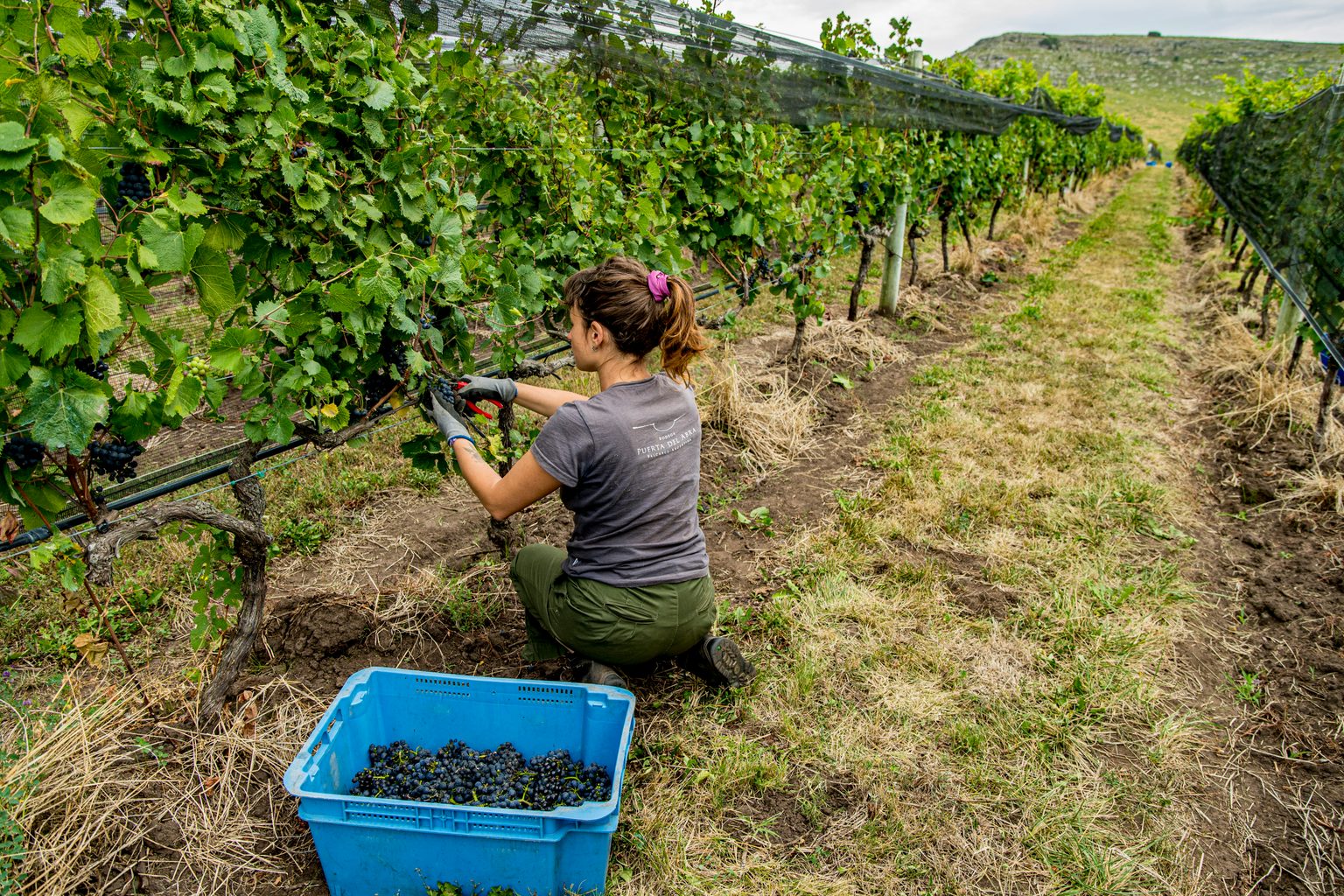
Puerta del Abra planted to match those conditions. Rather than leaning on Malbec, the vineyard is built around Chardonnay, Riesling, and Albariño for whites, and Pinot Noir, Cabernet Franc, Bonarda, Tannat, and Merlot for reds. Constant Atlantic breezes and moderate summer highs slow ripening and keep alcohol in check, while cool nights preserve acidity. The trade-off is weather risk. The area receives significant annual rainfall, and the vines face little natural shelter from the wind. The winery responds with mesh on the most exposed rows and carefully managed drip irrigation when local droughts or frost risk demand it. The goal is to let the climate shape the wines' tension and freshness while using human intervention as a scalpel, not a hammer.
Being first in a young GI also means building a culture around the vines. With no existing wine labor pool in Balcarce, Puerta del Abra has looked to hire locally, educating the team as they learn through the terroir and the processes. Inside the winery, collaboration and equal opportunity define the culture. The winemaking team has been female-led since Delfina Pontaroli established the production foundation, and today Mariana Boero serves as head winemaker with Deborah as assistant winemaker. In an industry where that remains uncommon, Puerta del Abra sees it as a natural expression of its values rather than a talking point.
Distinctly Atlantic in the Glass
In the glass, the wines feel distinctly Atlantic. The core Puerta del Abra line, presented under that name in the US market, represents the purest varietal expression of their estate vineyard El Vallecito. The Albariño channels its Old World roots through chalky soils and softer southern light, combining ripe fruit with a quiet mineral line. The Riesling ripens slowly enough to build aromatic complexity without sacrificing its spine of acidity. The Pinot Noir steps out from its traditional role as a sparkling base in Argentina to show an elegant, finely structured still red with real aging potential. The Chardonnay, developed under Velo de Flor, a technique closely associated with Jerez, has proven one of the estate's most compelling expressions. On the red side, Cabernet Franc has become a portfolio staple with pronounced pyrazine notes as a 100 percent single varietal, while Bonarda tends toward red fruit and gentle spice over a chalk-etched backdrop, and Tannat offers darker fruit with firm but polished tannins and a subtle savory note.
The Itzae line reinforces the exploratory spirit of the team. Each year, micro-vinifications of what is in the winery at that point in time help identify the most compelling expressions of the vintage, which are then assembled into a red and white blend. The result is a wine that changes character from edition to edition, reflecting the full diversity of what the vineyard has to offer in any given year.
Sustainability and Recognition
Sustainability is woven into every layer of the operation. In 2023, Puerta del Abra obtained vegan certification, formalizing its long-standing practice of avoiding animal-derived fining agents. The team has moved to lighter bottles, implemented Good Agricultural and Manufacturing Practices, and participates in Balcarce's Green Fridays program promoting environmentally conscious behavior.
Despite growing recognition from Decanter, James Suckling, and Global Masters, the estate has kept production intentionally modest at 40,000 to 50,000 bottles annually. Most domestic allocation goes to high-end restaurants in Buenos Aires, with a California-based import arm handling US distribution. Spain and France are already on the map, and the team is exploring further European markets where cool-climate styles and emerging origins resonate.
The estate's own words capture the spirit of what they have built. "We started this winery as a passion project of the family, something to be shared with those closest to us. As the project evolved, it opened new opportunities, but never losing focus of the foundational spirit. Today, we seek to find those in the industry that share that intimate passion for wine, willing to push boundaries and explore something new. For those, Balcarce awaits."
For Argentina, Balcarce is proof that the country's future is not limited to the Andes. For Puerta del Abra, it is a long-term commitment: keep listening closely to an ancient landscape, keep investing in people, and keep refining wines that could only come from this windswept valley between the sierras and the sea.